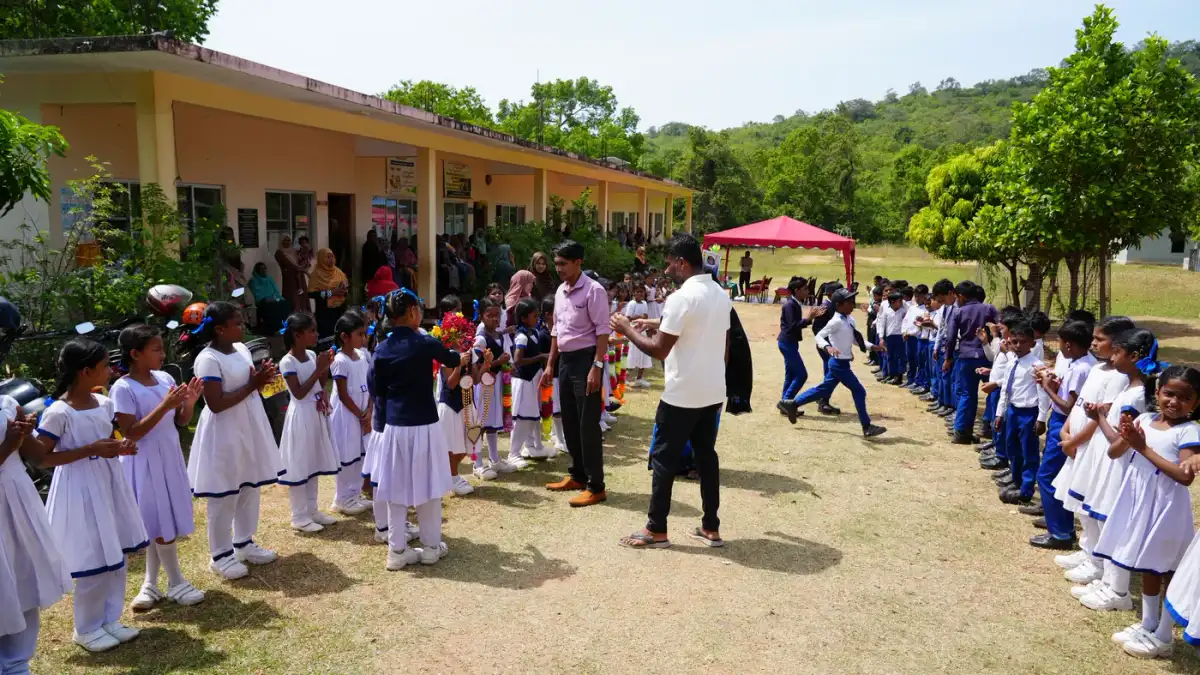
A young girl I had never met placed a flower garland over my neck (a typical gesture of respect shown to visiting guests), took me by the hand, and walked me to my seat. She was about the same age as my youngest. She was one of a hundred orphans our ground team had gathered that afternoon. It was 36 degrees outside and I had travelled across the world thinking I was going to give something to these children. Before I could, she gave first.
To understand why that afternoon mattered, you first have to understand where it happened. It happened in a part of the world that most charity, most government, and most attention has quietly agreed to forget.
The Place at the End of the Map
We landed in Colombo, Sri Lanka on June 15th 2026 and boarded a small Cessna for the flight east. Beneath us the island unfolded in greens and blues that look, from the air, like a country with nothing to worry about. That is the lie of altitude. We came down in Trincomalee, on the Eastern coast, facing the Indian Ocean, and within a day the distance between the postcard and the reality had closed completely.
Sri Lanka is a nation still climbing out of the deepest hole in its modern history. In April 2022 the country defaulted on roughly 46 billion US dollars of foreign debt, the worst economic collapse since independence. The headlines have since moved on, but the families have not. Poverty stood at 24.5 percent in 2024, almost exactly double what it was in 2019, after peaking at 27.1 percent at the height of the crisis in 2023. Food prices more than doubled between 2021 and 2024. The World Bank estimates that today roughly a third of all Sri Lankans are either living in poverty or sitting one shock away from falling into it. And the shocks keep coming. Late in 2025, Cyclone Ditwah flooded a fifth of the country and killed 687 people.
What the statistics show is the national picture. The Eastern Province is the part of that picture nobody photographs and few international charities ever visit.
The East spent thirty years on the frontline of a civil war that ran from 1983 to 2009. When the war finally paused long enough for the world to look, it was because the 2004 tsunami had killed around 35,000 Sri Lankans in a single morning and left close to a million homeless, much of the destruction concentrated on exactly this coast. The fishing economy that feeds these villages was strangled first by wartime restrictions and then by a wave that erased boats, harbours, and homes in twenty minutes. In Trincomalee District, the average household brings in around 240 US dollars a month. This is what official statistics would have us believe. Our on-the-ground experience tells us that even this meagre figure is often grossly overstated, as the poorest and most rural are not accounted for in a country where the infrastructure to reach them is limited.
There is another fact about this coast that explains a great deal, and it is the fact that brought our team here. Trincomalee has the second highest concentration of Muslims of any district in Sri Lanka. Across the East, the Muslim community, known historically as the Moors, is concentrated in districts like Trincomalee, Ampara, and Batticaloa. They live mostly as fishermen, farmers, and small traders. Kinniya, the town where we visited our second school, has a Muslim majority, was devastated by the 2004 tsunami, and sits 240 kilometres from Colombo. That distance is not only geographic. It is the distance between where donors fly and where the need actually lives. Tourist money lands in the south. The international NGOs cluster where the cameras already are. The Muslim, Tamil-speaking, fishing-dependent East is simply too far down the road for most of them.
This is the gap and I am proud to say, it is where Droplets of Mercy chooses to work.
A Team That Respects the Money
We began our first full day, the 16th of June, at the offices of our ground team. In Canada, I spend my days around capital and financial structures. The first thing I look for in any deployment of money, whether it is commercial or charitable, is whether the people handling it respect it. This team does. They stretch every single dollar and account for it with a seriousness that many institutions would struggle to match. Nothing here is wasted. That is not a soft virtue in a place this poor. It is the difference between a donation that disappears and a donation that changes a life.
I say this because donors deserve to hear it. Your sadaqah is not vanishing into overhead and good intentions. It is being tracked, allocated, and delivered by people who treat it as an amanah. Alhamdulillah.
Two Schools, and What a Backpack Costs
From there we went to Karimalayootru Vidyalayam, a primary school deep in a rural stretch of the province. The children here come from poor families, most dependent on the fishing industry. Until recently, access to technology at this school was near zero. Through your contributions, Droplets of Mercy had procured and installed a full smart classroom, and that morning we cut the ribbon on it. The children met us with a confidence and a talent that the conditions around them have no right to produce. Many of them walk several kilometres to reach this school each day. They eagerly shared whatever little they had with us without a second of hesitation.
Our next stop was Abdul Hameed Vidyalayam in Kinniya. It was thirty-six degrees outside, and the power held for the short while we were there (it often does not). We distributed school backpacks and supplies. A parent told me what a single backpack costs in this region: somewhere between 6,000 and 8,000 Sri Lankan rupees. For a fishing family making ends meet day to day, that is an impossible annual expense, multiplied by every child they send to school. So the children arrive with broken bags, or with none, and they fall a little further behind every year for the want of something a Canadian parent throws into a shopping cart without looking at the price. The smiles when they received their new supplies put my own privilege into a sharp and uncomfortable focus. An ice cream vendor happened to pass the school gate, so we called him in and bought every child something cold. The joy was palpable and soul nourishing.
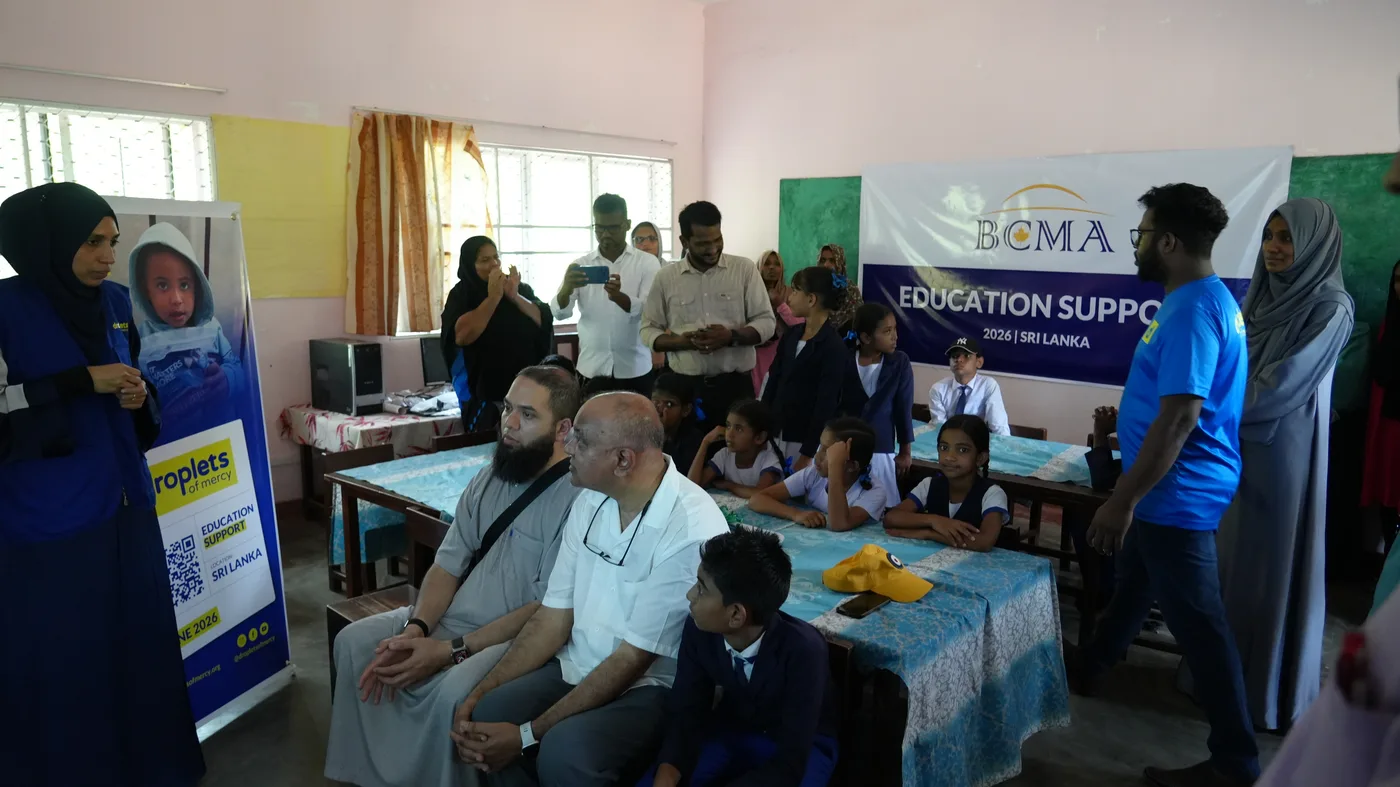
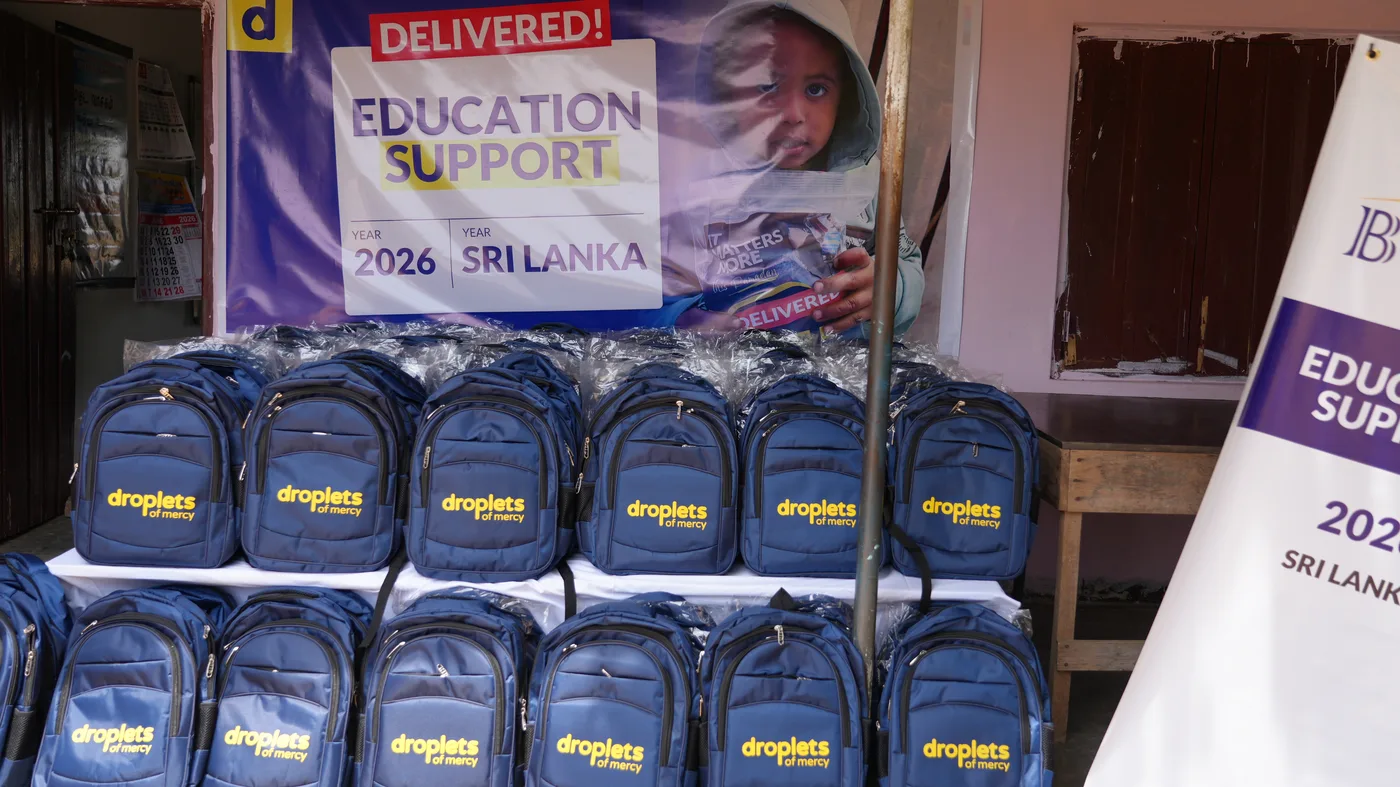
These are small interventions. A smart board. A backpack. That is exactly the point I want you to sit with. The gap that keeps these children behind is small enough to close. It stays open only because no one with the means is standing close enough to see it.
The Beach With a Hundred Orphans
Then came the afternoon I will not forget.
The Messenger of Allah ﷺ said:
أنا وكافل اليتيم في الجنة هكذا
"I and the one who cares for an orphan will be in Paradise like this," and he held up his index and middle fingers, parting them only slightly. (Sahih al-Bukhari)
Through our orphan sponsorship programme, the ground team had gathered one hundred orphans and their mothers. The mothers had dressed their children with a care that broke something open in me, because I knew what that care cost them. We served lunch and sat and ate among them. They performed nasheeds. They performed plays they had rehearsed for us. One play told the story of a family losing its father. I looked around the room and found not one dry eye among the adults. If watching it moved us that much, imagine the children carrying it.
We played tug of war. We handed out chocolate. The team had arranged an evening of sightseeing for us afterward, and we cancelled it without a thought, because there was no view on this island worth more than that beach.
This is the child your charity reaches. So much more than a statistic. Children with flower garlands and beautiful smiles who decided, before they knew anything about me, that I was worth welcoming and sharing a meal with.
The Gift That Ends the Need for the Gift
The next day reaffirmed something I have long felt about charity itself.
There is a hadith recorded by Abu Dawud. The account, narrated by Anas ibn Malik, may Allah be pleased with him, runs roughly as follows: a man of the Ansar came to the Prophet ﷺ begging. Rather than simply hand him money, the Prophet ﷺ asked what he owned, sold the man's few possessions, and used the proceeds to buy him an axe. He told him to go gather firewood and sell it, and not to return for fifteen days. When the man came back, he had earned far more than charity would ever have given him, and he had earned it with his own hands. (Sunan Abi Dawud)
That hadith is the entire philosophy of our second day in Trincomalee.
We spent the morning distributing income-generating gifts. Vending carts mounted on bicycles and motorbikes. Canoes for fishermen. Each one comes with a small starting budget so the recipient can stock up and begin earning immediately. A man with one of these carts can earn 1,500 to 3,000 rupees a day. That is enough to feed his family and, more importantly, enough to stand on his own two feet and hopefully never need us again.
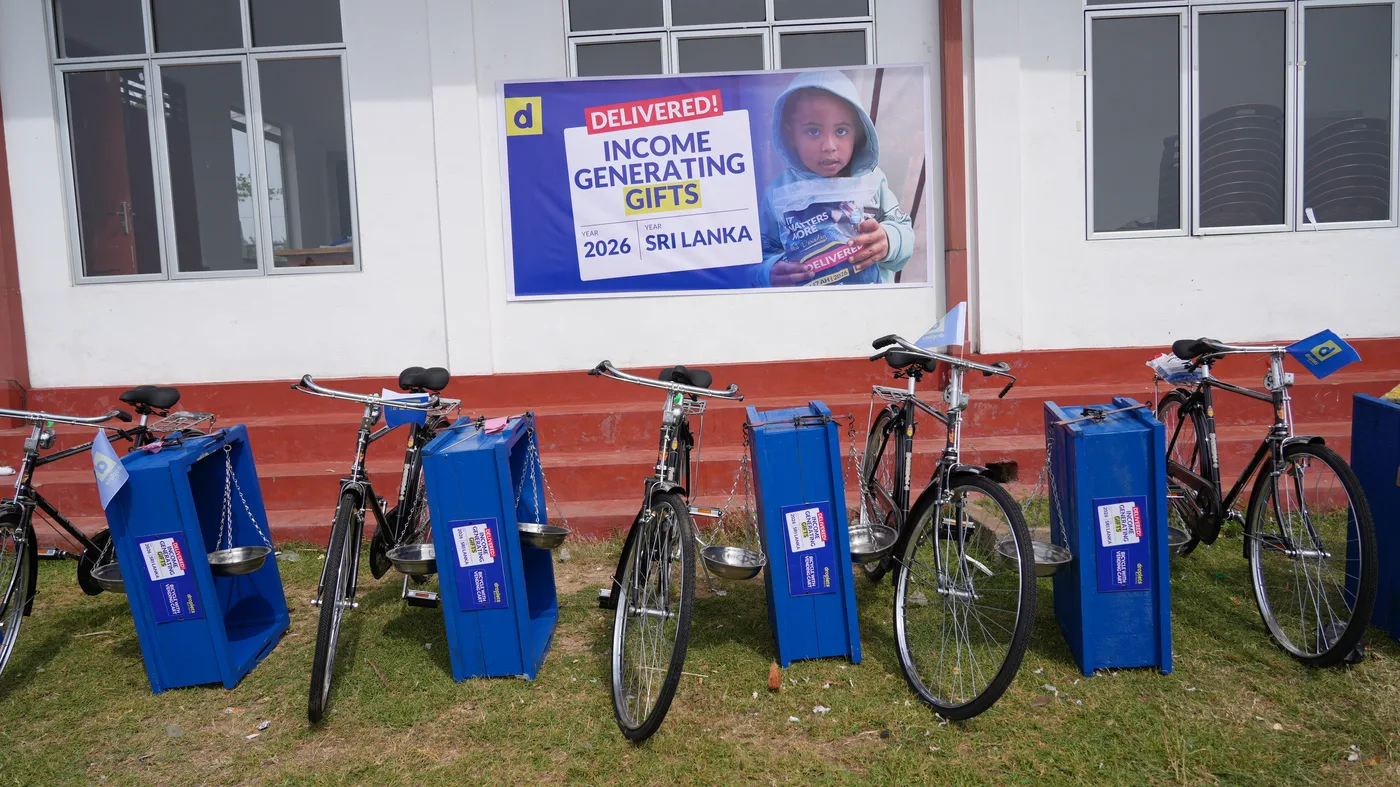
The moment that stayed with me came in a remote village, in the home of a widow. This woman lost her husband and refused to let that be the end of her family's story. She had built a small grinding mill business, taking orders from local shops, grinding rice and wheat flour, making the staple string hoppers that are eaten across Sri Lanka. Nor did she dwell on her own survival. She brought the other women of her village to work with her. Droplets of Mercy delivered her a larger mill, lifting her output from around 5 to 7 kilograms a day up to 25. More for her, and more for every woman whose income now runs through her hands. Despite her modest house, she insisted we sit and eat the string hoppers she had made in front of us. We could not refuse. Subhan Allah, the dignity of someone who has so little and still serves.
Then we visited families where poverty is hard to put into words. A family of seven living in a mud hut under a straw roof. No bathroom; they use a nearby lake. No kitchen. No running water in the village. I was told that 5,000 USD builds a permanent two-bedroom home with a kitchen and a standalone bathroom for a family like this. Five thousand dollars to move human beings out of conditions no human being should live in.
In other homes, a child or a parent is sick with something the local clinic cannot treat. The government will provide the treatment for free, but it is hours away in the capitol, and the family cannot afford the bus fare to reach it. Imagine that for a moment, the treatment exists. The road to it is what they cannot afford.
And yet remarkably, in every single home we entered, the children were in school and in madrassa. Some of them walk several kilometers each way, hungry, to get there.
Why This Is the Work That Matters
Step back and see what these two days actually show.
On one side, you have a region the world has decided is too far, too complicated, and too quiet to prioritise. A Muslim-majority coast, battered by war and then by water, where the average family lives on less than 200 dollars a month and the aid convoys mostly do not come. On the other side, you have a model of charity that does not simply soften poverty for an afternoon. It ends it. A mill, a canoe, a cart, a backpack, a smart board: each one is calibrated not to create a dependent but to retire one, in sha Allah.
Relief that keeps a family alive until the next handout is not the same as relief that lets a family stop needing handouts. The first is easier. The second is the kind the Prophet ﷺ practised when he reached for an axe instead of a coin. It is harder, it is slower, but it is the kind worth scaling.
Droplets of Mercy works where the need is greatest even if the attention isn't, and it works in a way that treats the poor as people with hands and futures rather than as a permanent line item. That combination is admirable. I went to Sri Lanka to inspect the work. I came back convinced it is exactly where our community's money belongs.
Be the Two Fingers
The Prophet ﷺ did not promise nearness to himself in Paradise for those who feel sympathy for orphans. He promised it for those who care for them. The distinction is the entire deen. One is an emotion. The other is an action with a cost.
If this reached you, do not let it end as a feeling. A backpack is a few dollars. A cart is a family's independence. A home is 5,000 dollars and the rest of someone's life. Every dollar reaches a child, because I watched it reach them.
Support the work of Droplets of Mercy in Sri Lanka. I look forward to implementing many more projects and visiting the country again in the near future in sha Allah. If you would like to join me in this life-changing work, reach out through Droplets of Mercy.
The aid trucks stop where the road gets hard. For Droplets of Mercy, that is exactly where the work begins.